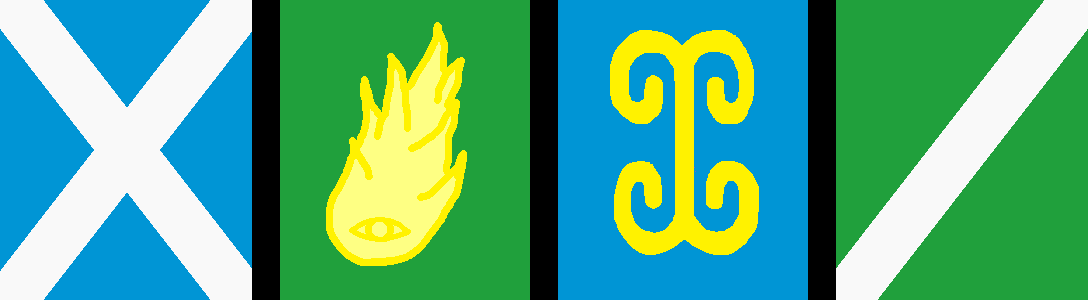
‘Itaria’ may well be the first strange word you’ve heard regarding this collection we call the Thornlands. If it is, then you’ve made an excellent start – hooray! – because this word refers to everybody in the world. It comes from a language called ‘Hadarotian’ (which you probably will encounter again soon enough) and it translates literally as, strangely enough, ‘the world’s people.’ Think of ‘Itaria’ as the equivalent of ‘humanity,’ and an ‘Itarin’ as the equivalent of a ‘human.’
According to most tales, when Itaria began, it consisted of just four peoples: the Nef, the Alast, the Des, and the Artut. The world contained two great continents, as it still does today, and two peoples lived on each. On the northern of the two, the Nef lived in the chilly highlands while the Alast settled the swampy lowlands. On the southern, the Des lived on coasts and peaks amongst humid rainforests while the Artut inhabited wide plains far to their south.

You must understand, Itar, the world of the Thornlands, is not very large, – perhaps smaller than earth as much as tenfold, – and even these most ancient of people knew of one another at least vaguely and interacted at times. And, though they differed greatly, they all shared a common belief – at least, their descendants who entered recorded history did – that a great Power once walked among them, and, before departing (if you could call it that), this Power left behind four essential pieces of humanity, contained within precious stones, for the people to guard over for themselves. As you could expect, each of the four original Itarin peoples possessed one of these stones.
The Nef guarded the Stone of Life, which held the souls of all people in place and thus allowed them to enjoy the surrounding world.
The Alast guarded the Stone of Knowledge, which held the minds of all people; without it, Itaria would be rendered completely indiscernible from the wild beasts.
The Des guarded the Stone of Wisdom, which contained Reason. If it were lost, Itaria would assuredly crumble to despair.
Finally, the Artut guarded the Stone of Peace, which held the hearts of all people. Ironically, if this stone were lost, Itaria would probably be more peaceful. But it would also be really dull.
For the most part, these stones are shrouded in mystery – especially the Stone of Life, which only ever seems to appear in old myths. Nevertheless, you will find a few of these stones play active roles in the course of history. For instance, the Stone of Knowledge passes through the possession of many kings of Hadarotia in the form of a small, translucent, deep-blue gemstone. Whether it is indeed the same stone as the one guarded by the ancient Alast in their swamps, I honestly cannot tell you.
There isn’t much more to say about these ancient four peoples, aside of course from the legends to which they belong, but they certainly make it easy to explain what the term ‘Itaria’ refers to. By the time people enter recorded history, they’ve fragmented themselves into dozens of individual nations. Those four ancient names can still be used as general categories, but that’s all they’re good for – generalization. Plenty of nations don’t fit well into any of the four, though they inevitably end up in one anyway. It’s much easier to keep track of everybody that way.
Here are the Hadarotian terms for the four peoples, along with very rough summaries describing each:
Nefrovia – These fair-skinned, fair-headed, five-fingered people inhabit the mountains and tundra of the northern continent, and they are heavily fragmented into hundreds of tribes. They bear a reputation throughout history of maintaining a common culture, belief system, and language amongst themselves despite having very little to do with one another (though some collections of tribes do confederate over time). This is most likely because said common culture fears innovation in just about any form, or maybe because a breach of tradition is the fastest way to set tribes against one another. Needless to say, Nefrovian countryside is often considered backwards and uneducated, and I’ll admit, more often than not, that appears to be a fair assessment. Just don’t mistake ‘backwards’ for ‘incapable.’
Alasthia – These are forest-dwelling people who live on the southern rim of the northern continent. Historically divided into a large collection of tribes, the Alasthians often dream of unifying into a nation state called ‘Hadarotia,’ the term for their mother-culture. In fact, some form of an anointed ‘King of Hadarotia’ reigns in Alasthia continuously for most of their history, even though most of these imperial monarchs, in reality, rule over very little. The Alasthians are light of skin, dark-headed, five-fingered, and short in stature. They tend to think very highly of themselves as a people, and they’ll squabble over just about anything.
It can be difficult, especially in later times, to distinguish between Alasthians and Descians, as the two share a lot of history with one another. Only long-lived members of either group can tell the difference on the fly – and they’re wrong often enough too.
Descia – This is by far the most complicated and impractical of the four categories, because it is almost impossible to generalize Descia’s various members. At any period in history, they can be found living just about anywhere (except among Nefrovians, probably). They vary wildly in appearance, and at most periods in time, they have no sense of unity with one another at all. Those in this group include the Fescians, – native to traditional Des, four-fingered, very dark-skinned and tall in stature, with no hair on their bodies at all, – the Rote-Bromuns, – native mostly to the area between the two continents and also dark-skinned, but they happily have dark-shaded hair on their heads and five fingers, – the Salakians, – native to the far southwest and similar in appearance to the Rote-Bromuns, but fairer and four-fingered, – and finally, those who actually call themselves Descians – tall, slender, and pale with smooth, very dark hair, five-fingered, ironically the most mixed-blood of all the Descians. In fact, the self-named ‘Descians’ tend to resemble Alasthians so closely that it can be difficult, maybe even pointless, to tell the two apart.
You got all of that, right? All this confusion is thanks to an ancient empire called Fescia, ruled of course by the Fescians but expansive and highly cosmopolitan in nature. Aside from this, the only things the Descians really have in common are narrow, coal-black eyes, protruding chins, and small ears. Plus they’re all lefties, for some reason.
Artutta – the plains-dwellers of the southern continent usually boast the highest population in the world. Like the Nefrovians, they have a habit of isolating themselves in their familiar homeland and often are misunderstood by the rest of the world. But unlike the Nefrovians, the Artuttans are very diverse culturally and religiously, and they observe strong traditions of tolerance. In terms of appearance, Artuttans sit in the middle of the spectrum regarding hair and skin color as well as stature. They have four fingers, bright and wide eyes but slim faces, and very curly hair. For women, the growth of facial hair is unusually comparable to that of men (no, it’s not a testosterone thing), and in fact, some styles of facial hair are considered feminine among Artuttans.
Confusingly, people from the northern continent closely associate Artuttans with dark skin. This widespread misconception begins during the time of the Second Artuttan Empire, whose emperors are to thank for their favored conscription of Fescians into their armies.
 Tales from the Thornlands