
Imagine you were born an Hadarotian. What would daily life be like for you? What would your community be doing at a given point in the week? And most importantly, when do you get to celebrate Christmas?
I hate to disappoint you, but on the Hadarotian calendar, there is no Christmas. Hopefully you aren’t too surprised. But back to the point – how does an Hadarotian see a week, a season, or a year? Let’s start with the numbers. On Itar, a year lasts 300.21 days, which is great for the Hadarotians, because they love the number five (and not so great for the Artuttans, who prefer nine). A week has five days, and a month has five weeks. If you do the math, you’ll find this leads the Hadarotians to a twelve-month calendar, with three months to a season. Funny coincidence, isn’t it?
In addition to this, once every twenty-five years Hadarotians observe a thirteenth month, called Inyerneness, which lasts for one week. Unfortunately that still leaves us with a one-day drift per century, but it could be worse – like the Artuttan calendar.
It’s also worth noting this is strictly a solar calendar, despite my use of the term ‘month.’ The moon Ren undergoes a thirty-seven and a half day cycle, so proper lunar calendars see eight months to a year. Some of the Hadarotians’ ancestors observed a lunar calendar before this Hadarotian calendar was invented.
Each day begins at sunrise, and the five days of the week (Gaiser, Lainalor, Baser, Doser, and Maiser) are named after the sky-lords of legend. This cycle has been observed since ancient times and once held ritualistic implications, a topic for another time. The only consistently special day is Maiser, also called Week’s End, when communities typically gather for worship. They also tend to break from work on that day, though it isn’t the religious expectation some of us observe.
Many calendars actually drop the name Maiser altogether and just call the day what it is, Kidopdast, which literally means “day of cycle’s end.” Week’s End. Nobody really likes the Lord of Metal anyway. He’s evil.
While you don’t get to celebrate Christmas as an Hadarotian, the first day of every month is a holiday of some importance. Most holidays bear the same names as the months they fall on, and all are meant to reflect a spiritual theme associated with their respective months.
You would still have your yearly birthday celebration as an Hadarotian, but you wouldn’t get any cake. Hadarotians don’t like spongy pastries. Plus, regardless of what day you were actually born, you would consider yourself a year older on the very first day of your birth-month, and you might not even bother remembering the exact date anyway. You also would learn from a young age that the month of your birth will play a role in your life’s destiny – perhaps it will be a single event, or maybe something that lasts your whole life. You may miss out on it entirely if you aren’t paying attention.
Here is how your birth month would influence your destiny – if you were an Hadarotian, of course. If you aren’t, this doesn’t apply to you. Though if you’re curious, the Hadarotian calendar year begins roughly in coincidence with the first day of spring (so if you were born in the second half of March or the first half of April you’re an Inerben, and so on).
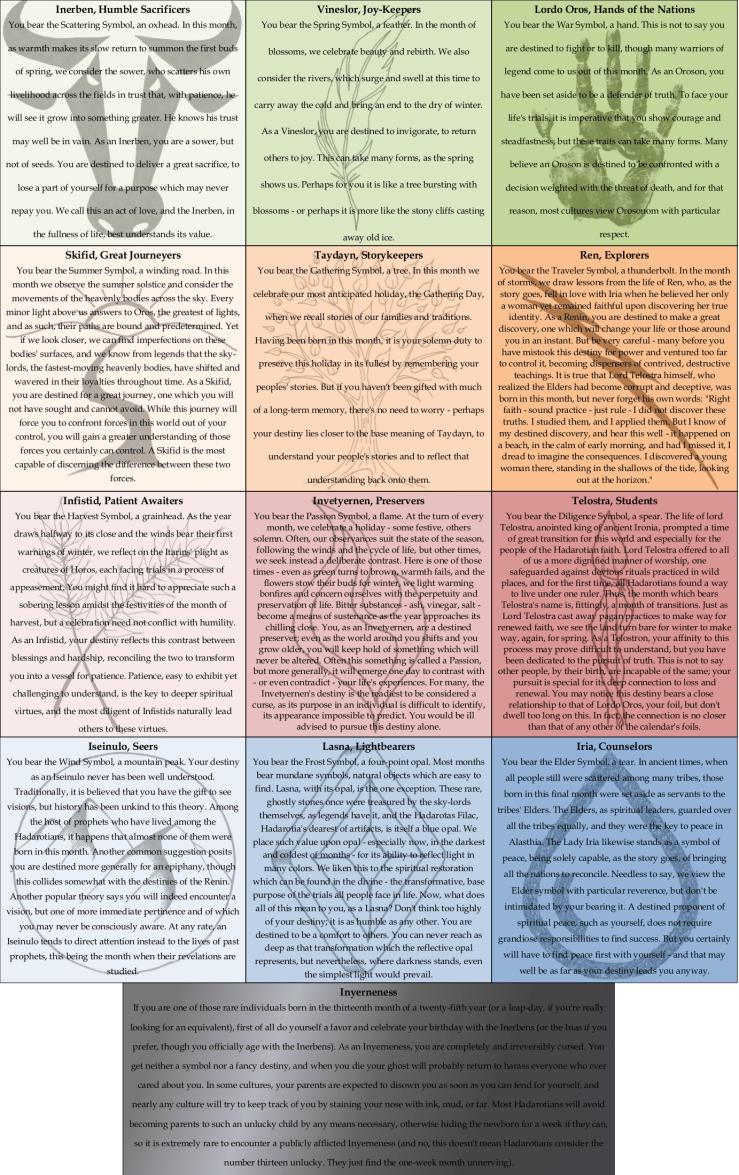
And there’s still more to consider. If you were born within the year’s first six months, you were born with a warm, outgoing temperament; in the other six, you were born with a cold, subdued temperament. Your temperament may have changed dramatically since then, but a part of you still belongs to your first breaths, the basis of your personality. Hadarotians don’t have much of a concept for the past (which isn’t surprising, considering their language doesn’t even offer a past tense), so they don’t see life elapsing on a continuum as we might. They like to make analogies out of trees and buildings, where the roots or the foundation remain as relevant – more so, even – as the outermost features.
Furthermore, your month of birth will probably influence how well you get along with other people. You will find it easiest to relate to members of your own month – maybe too easy. Hadarotians believe friendships develop most naturally between people of neighboring months, while members of the same month more often get in one another’s way and form rivalries. You will encounter the most contrast in a relationship between a warm month and a cold month, and members of months exactly six apart are considered foils to one another. While this of course creates obstacles, the spiritual roles of these six-month pairings directly complement one another. This can prove risky, though. Five-month pairings can also hold power and are considered relatively safer, while four-month pairings don’t hold power at all and could prove too risky to be worthwhile.
There’s also the devious superstition that members of the month three ahead of yours are the most likely to betray you, while those three months behind you are the most likely to save your life. It sure would be interesting if both turned out to be true. Think about it.
Of course, warm-cold temperaments also come into play with these pairings. Opposing temperaments introduce volatility to a relationship, which means each month faces a unique field of possibilities. It’s an endless debate whether Inerbenim, Renin, Infistidim, and Irialin lead more or less challenging lives than Orosonom, Skifidim, Telostron, and Iseinulom. The former face volatile two-month pairings, while the latter can’t avoid volatile four-month pairings.
As you can see, the Hadarotians devote a lot of their cultural attention to these symbols, even though the symbols aren’t Hadarotian doctrine. The Kribbon culture is the most extreme example, where your month of birth governs your everyday responsibilities, dictates who may and may not be your teacher, affects which titles you can and can’t receive, and sometimes even determines who you will end up marrying. Religious leaders throughout Hadarotia embraced these traditions and tied the symbols into the months’ holidays. Actually, I’m not sure which came first – the holidays or the symbols. Their meanings are inseparable.
These symbols find further significance on Lordo Proldom, Taydayn’s holiday. On this day, the peoples of Hadarotian communities (as well as some neighboring communities – it’s a popular holiday) gather together and paint themselves with a set of symbols called a Fosrat. The Fosrat identifies who you are as a person, and it contains four parts. The first is the symbol of your faith, the second of your people, the third of your family, and the fourth is your birth-symbol. The holiday focuses on each of these four categories in turn, with people sharing instructive or commemorative stories, and then in the evening there’s a feast and a party of some kind.
If you live in the country of Andonia, you would also wear a fifth symbol over your heart. What the symbol should be and what it should mean is entirely up to you, and no one else is supposed to see it (not that I have to tell you that, because you’re a decent person anyway). I’m not sure how or why this tradition developed, but I can imagine the Andonians got bored of everyone’s Fosrat being the same. They aren’t exactly known for heterogeny.
At heart, Lordo Proldom is for the children. In the largest of cities, though, it’s something entirely different – huge parades, week-long festivals, and of course a great many heritages, typically shielded from outsiders, openly displayed on this day for all to see. Granted, that’s not so extraordinary to us in these times, but to them, it must have been exciting to see the exotic Fosratom of travelers.
 Tales from the Thornlands