
Seeing Itar from Earth would be somewhat difficult (and I’m not an astronomer, so don’t ask for my help if you go looking), so as you can imagine, Itar’s sky of stars looks very different from our own. But I will save the constellations for another article and focus here instead on the more mobile of heavenly bodies.
To begin, two moons orbit Itar – Iria and Ren. Ren has a pinkish-red surface and appears from Itar to be about half the size of Earth’s moon; it follows a thirty-seven and a half day cycle across the sky. Many Itarin cultures in history employ a Renen calendar to follow the seasons, with each cycle marking a new season in an eight-part progression. The Nefrovians are an exception to this; their homeland lies at a greatly northern latitude, and Ren’s orbit is inclined by nearly twenty degrees. As such, the Nefrovians can go weeks at a time without seeing Ren in the sky, day or night.
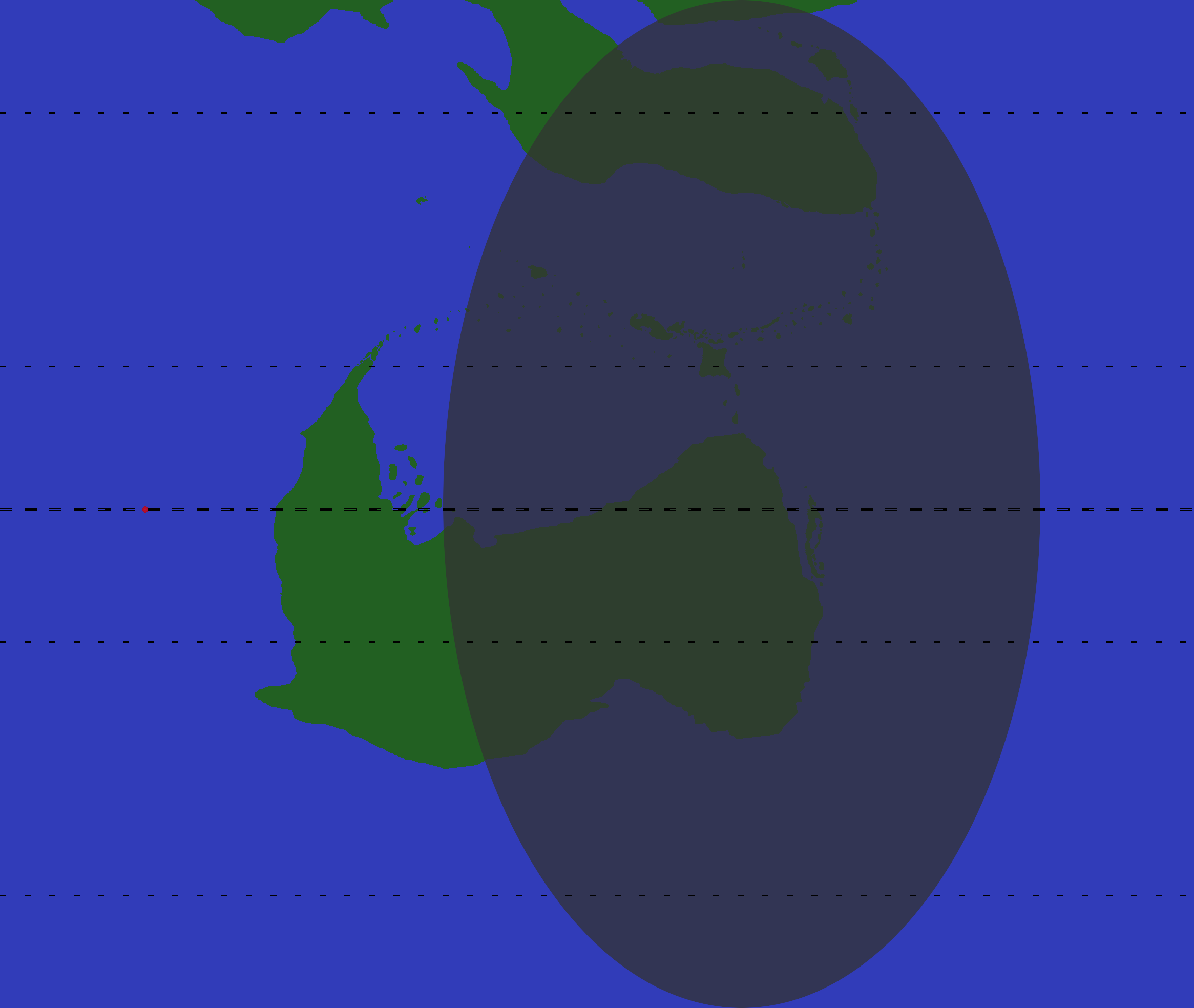
But Iria proves even more elusive as a satellite, for the fact that it never moves from the same place in the sky. Iria’s orbit around Itar lasts exactly one day, and so there is a point on the planet – and one point only – where Iria will always appear directly overhead. And for those who can see it, it is quite the sight – bright and silvery, the size of a golf ball in appearance, and close enough to watch its shadows chase the sun across the sky. But unfortunately for many Itarins, the point where Iria appears directly overhead lies in deep ocean, far from land. The country of Des gets the best view.
Seven other objects outside the star-field are visible. There’s the system’s central star, of course, called (I’m using Hadarotian names, by the way) Horos – it appears slightly smaller to Itar than the sun does to Earth. The rest are visible planets – Mays, Dos, Layros, Basros, Gaysros, and Nayr-Alsin (or Palo to the Sketjok). The first five derive from alchemical terms. Mays and Dos refer to the two states of physical matter – solid and disperse, or orderly and chaotic – as well as to two of the five elemental components of matter – the crystalline and the organic. Layr, Bas, and Gays refer to the three states of physical motion – falling, flowing, and stationary – as well as to the other three elements – the fiery, the watery, and the earthen. In fact, the Hadarotians use these same five terms for many different purposes (because they like the number five. A lot).
You might encounter some of these names fairly often as you explore the Thornlands. As you can expect, a number of them appear as characters in traditional legends. But that is for another time.
Now for a few comparisons between Earth and Itar. Itar is slightly larger than half the diameter of Earth, and dry ground makes up about fifteen percent of its surface (about 9.7 million square miles, if you’re curious. Pretty cramped by our standards). Itar’s orbit and rotation both are slightly slower than Earth’s, leading its year to last about 375 Earth-days or about 300 Itar-Days (300.21 to be exact. Leap years get complicated). If you, accustomed to your Earthly day-night cycle, were to try to live on Itar, you would observe each day to last about thirty Earth-hours. And you would probably suffer from insomnia.
For posterity: the Hadarotians divide each day into five equal parts, called ‘great-hours,’ each of which is divided into five ‘small-hours’ (each of which is divided into one-hundred twenty-five minutes, each of which is divided into twenty-five seconds). The first great-hour begins at sunrise. If I ever make a time reference in my work on Itar, assume I am using this scale. If I use the word ‘hour’ by itself, assume it is a reference to a small-hour.
 Tales from the Thornlands